W.P. Hackney, the Civil War captain and state senator behind Winfield’s limestone house on 10th
William P. Hackney was wounded twice in the Civil War, served in both houses of the Kansas Legislature and as Winfield's mayor, and built the 1886 limestone house at 417 E. 10th Ave.
By Jolene Marquardt
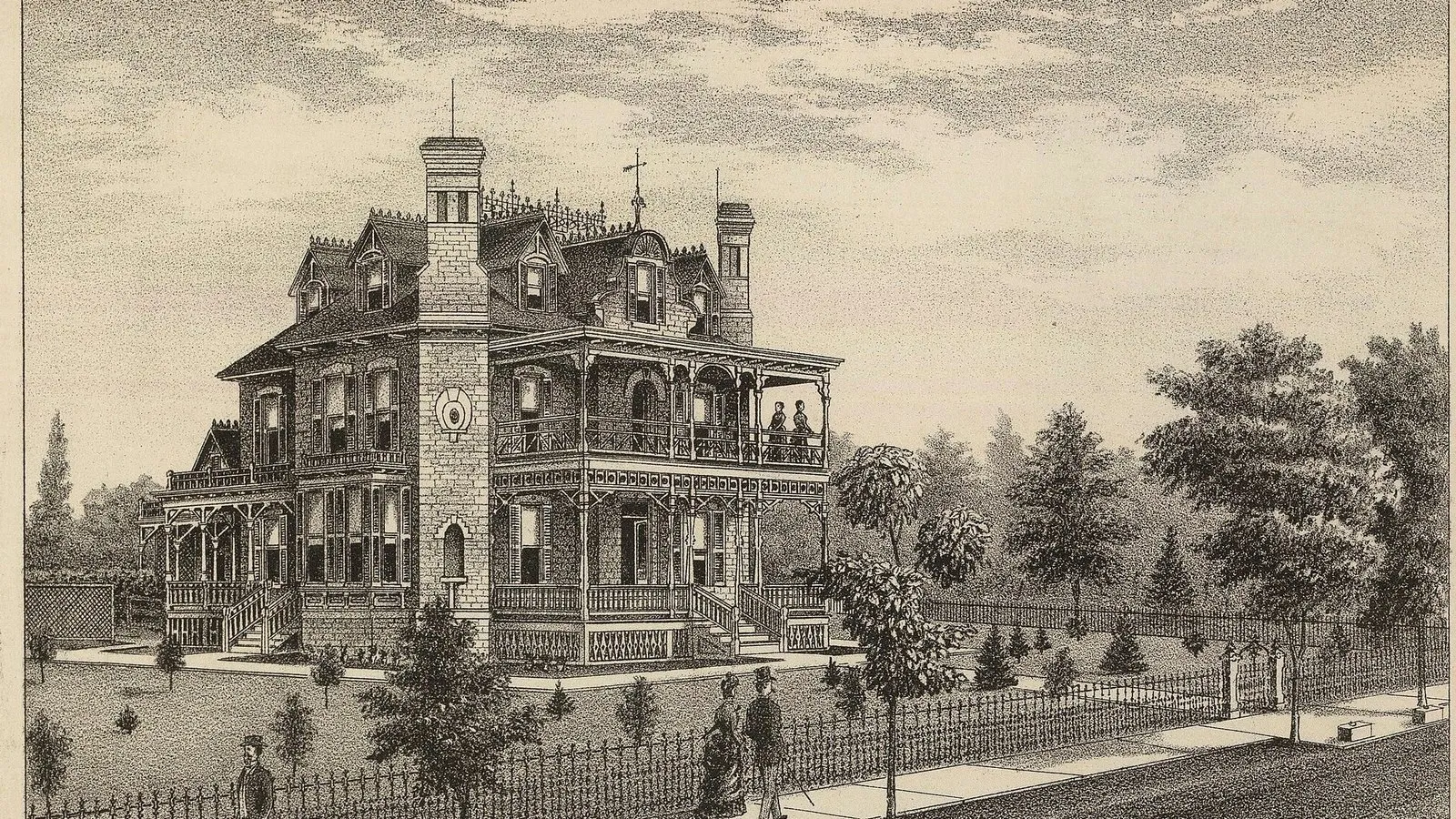
_Residence_of_T.H._Soward_..._Winfield,_Cowley_Co.,_Kan._(L.H._Everts_%26_Co._(IA_dr_residence-of-wp-hackney-winfield-kansas-with-residence-of-th-so-00814112).jpg)
William P. Hackney came to Cowley County in 1870 with a law license, two Civil War wounds and a captain’s commission. Over the next two decades he won a seat in both houses of the Kansas Legislature, served as Winfield’s mayor and put up more than a dozen buildings in town, including the limestone house at 417 E. 10th Ave. that still carries his name.
Most of what is known about him comes from two places: the National Register of Historic Places nomination for the W. P. Hackney House, prepared by the Kansas State Historical Society, and the Cowley County Historical Society Museum’s compiled history of early Cowley County figures, which collects his record from period newspapers.
Shiloh to Allatoona Pass
Hackney was born Dec. 24, 1842, in Jefferson County, Iowa, according to the museum’s history, and grew up in Logan County, Illinois, after his family moved there in 1850. He enlisted in the Union Army as a private in 1861, at 19.
He was promoted to sergeant at Fort Donelson and fought at Fort Henry, Shiloh and Nashville, among other battles. At Allatoona Pass, Georgia, on Oct. 5, 1864, he was hit twice: one ball went through his right cheek and another through his body. He left the Army a captain, with an honorable discharge in July 1865.
He began studying law in 1866, was admitted to the bar in 1867 and married Callie L. Vandeventer in January 1868.
Claim jumpers, horse thieves and the Statehouse
Hackney first arrived in Cowley County alone in 1870 and moved his family to Arkansas City, then to Belle Plaine in Sumner County in 1871. By 1875 the family had settled in Winfield, the county seat.
The National Register nomination says he “rapidly gained a reputation as an outstanding lawyer.” His first case, by the nomination’s account, was for settlers whose land had been taken by claim jumpers, and he won it. He also represented a group of vigilantes formed to drive organized horse-thief gangs out of southern Kansas.
Voters sent him to the Kansas House from Sumner County in 1872 and 1874 and from Cowley County in 1876 and again, three decades later, in 1905. He served in the Kansas Senate from 1881 to 1885 and was, in the nomination’s words, an “active and influential” figure in the state Republican Party for years.
The museum’s history credits him with a few measures that still echo locally. In 1881, the year Kansas created an institution for children with developmental disabilities, he introduced a bill to locate it in Winfield. It opened temporarily in Lawrence and moved to Winfield in 1887 and 1888, growing into the state hospital that was Winfield’s biggest employer for 117 years. The same history says he introduced a temperance bill and a joint resolution for equal voting rights for women and men.
Hackney was also general solicitor for the Santa Fe Railroad, which named a station for him. That stop became the small Cowley County town of Hackney. He was elected mayor of Winfield in 1887.
A house the Courier called the best in town
Hackney’s buildings included a large business block built in 1887 and 1888, but his house is the one that lasted. Winfield architect William Caton designed it in 1886: three stories over a full basement, about 80 feet long and 40 feet wide, with walls of hand-hewn native limestone laid in a random pattern that gives the house what the nomination calls “a rugged massive appearance.”
The Winfield Courier described it on Dec. 30, 1886, as “first among the most commodious of the city, modern in exterior and interior, and furnished with a richness and subdued splendor.” A 1901 account called it “the handsomest and most substantial residence in the city.”
The house that stands today is plainer than the one in the 1887 state atlas lithograph at the top of this page. Two large wooden porches came off in the 1930s, and the ornamental ironwork visible in early views is gone. The nomination says Caton reportedly planned the remodeling himself so the original design would hold. The limestone, the angled street corners and the two chimneys with their carved stone circles are still there, a few blocks from the 1892 Coffin House on East 11th.
The house was listed on the National Register in 1973, when it was owned by L. F. Jarvis, and is sometimes called the Jarvis House.
Later years
In his later years Hackney became an advocate for rebuilding the American merchant marine. He printed his arguments at his own expense, and the nomination says his 1921 pamphlet “A Merchant Marine and a Marine Insurance Company” reportedly helped push Congress toward reform.
He died July 28, 1926, at the Sawtelle soldiers’ home in Los Angeles.
The Hackney House is a private residence, so it is a sidewalk stop rather than a tour. The Cowley County Historical Museum, which keeps the county’s early records and is housed in the 1880s Bryant School, is the place to dig further. More Cowley County lives, including Cambridge farmer and congressman Benjamin Clover, are collected in our In Profile section.