Bryant School, Winfield’s last 1880s ward school, has housed the county museum since 1967
Built for the second ward in 1880 and closed in 1964, the limestone school at 1011 Mansfield St. was nearly razed before the historical society took it over.
By Janessa Ricke
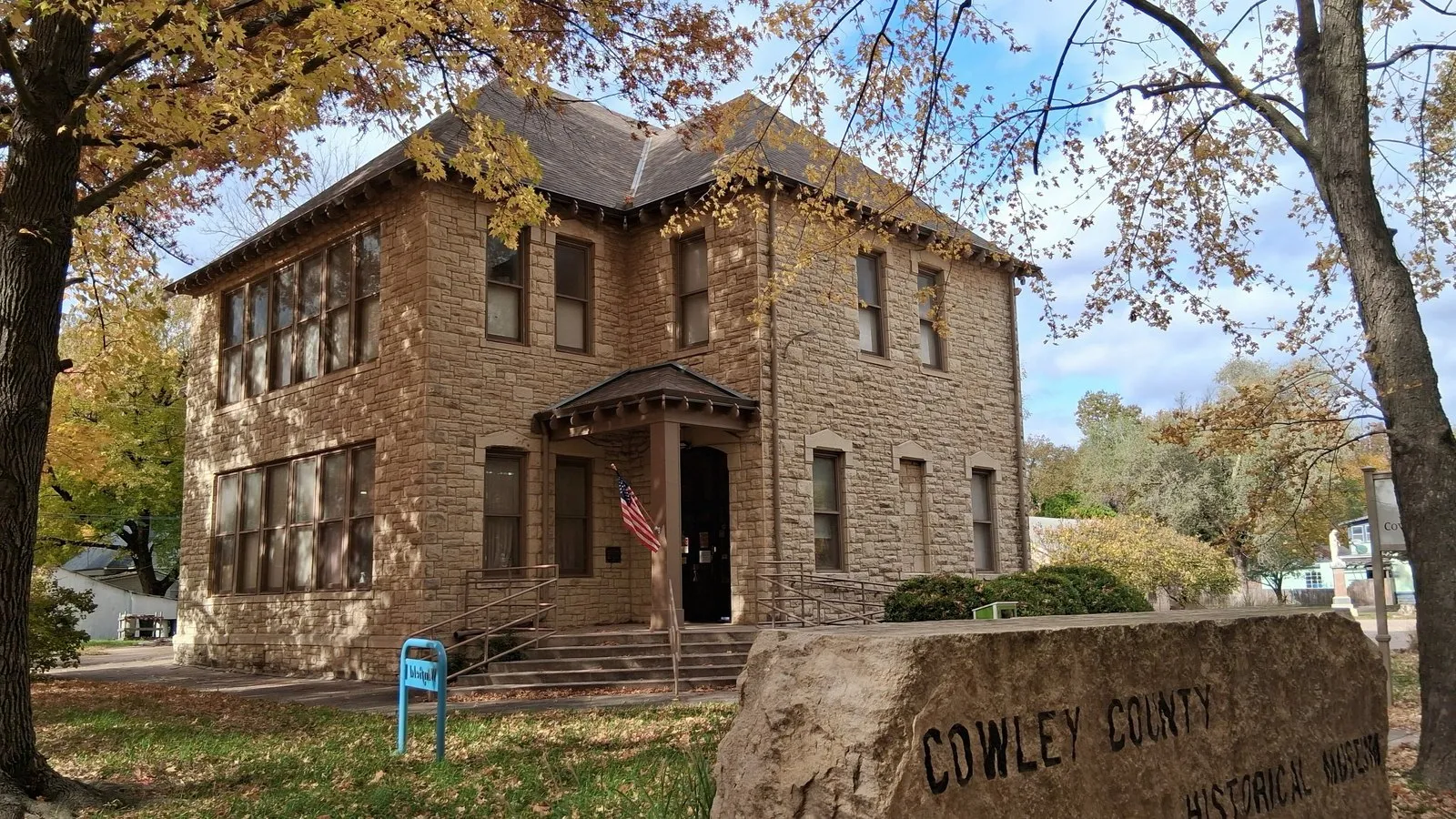

The limestone schoolhouse at 1011 Mansfield St. was contracted for $9,950 in 1880, taught west-side Winfield children for more than 80 years and was nearly torn down in 1966. Instead it became the home of the Cowley County Historical Society Museum, which still owns it and opens its doors five afternoons a week.
Bryant School is the last survivor of Winfield’s first round of public school buildings, according to its National Register of Historic Places nomination. The building was listed on the National Register on Oct. 4, 2017, under the Historic Public Schools of Kansas theme, for its place in the city’s education history and as a local example of what historians call a city graded school.
A school for the second ward
When Winfield became a city of the third class in 1879, it was split into two wards along Main Street. By 1880 the town had close to 3,000 people, and the school district clerk counted 780 school-age children, the nomination says. The board bought a quarter block in Manning’s Addition from Henry Brown for a second-ward schoolhouse.
Benjamin J. Bartlett, a Des Moines architect who specialized in schools and churches, designed it. The Winfield Courier reported in June 1880 that the contract went to John Q. Ashton, who had built the Arkansas City schoolhouse, for $9,950. Construction began that November. The result was a two-story, four-classroom building of locally quarried limestone laid in an ashlar pattern, with a bell steeple on top.
The name is a small mystery. The nomination states plainly that historic records do not say why the school was called Bryant. It also went by West Ward School, Second Ward School and Western Public School.
The city kept growing, from 2,844 people in 1880 to about 6,700 in 1910. That year Bryant had 154 students in its four rooms. In January 1916 voters approved $72,000 in school bonds, and architect J. M. Fuller added a two-classroom wing to the west in stone that closely matches Bartlett’s original. A separate kindergarten building went up on the north side of the lot in the early 1920s.
The flood that emptied the west side
The Walnut River flood of June 1923 changed the neighborhood. The nomination puts damage in Winfield alone at $1 million to $1.5 million, with whole residential blocks on the west side destroyed. Families who rebuilt tended to move east, away from the river, and the second ward’s school-age population fell even as the city grew.
Bryant kept going anyway, teaching kindergarten through sixth grade. In 1938 architect William Caton modernized it with the building’s first indoor restrooms, a central concrete stair, new double doors and a fire escape. The south entrance still carries the stylized “Bryant School” lettering from that project.
The end came in May 1964. The Winfield Daily Courier reported that the school was closing because there were too few school-age children left on the west side, and the students were consolidated into another school in 1965.
Saved from the wrecking ball
In 1966 the board of education decided to raze the building. Roland Mueller, an early museum board member, wrote in his recollection of the museum’s founding that a small committee asked to use it instead. After a favorable public meeting on Aug. 22, 1966, the board deeded the building and grounds to the historical society on Oct. 10, on the condition that it be used as a museum and open at least four days a month.
Volunteers cleaned and painted every room, repaired windows and installed heating and air conditioning. The museum opened on Memorial Day, May 30, 1967, with nearly 350 members signed up. A public contest first picked the name “Kickapoo Museum,” Mueller wrote, but the board switched to Cowley County Historical Museum after a prominent donor objected.
Later work added an elevator and ramp in the 1990s, a basement research library in 2004 and a one-story annex on the north side that houses an antique fire truck on loan from the City of Winfield. Some of the old school survives inside, including a slate chalkboard and a water fountain in one classroom, the nomination notes.
Bryant is one of several Winfield landmarks we have written about, along with the Carnegie library on Millington Street and the 1892 Coffin House. Arkansas City has its own saved school, Ireland Hall.
The museum is open Tuesday through Saturday from 1 to 4 p.m., according to Cowley County’s museum listing, and can be reached at 620-221-4811. Its events page lists free programs, with donations going to the Winfield Community Food Pantry, and the society is selling its 2027 calendar for $10. More local stories are on our Community page.