Winfield National Bank’s 1923 limestone building at Ninth and Main is the third bank on its corner
No bank has operated at 901 Main since 1945, but the Classical Revival building is the third on a corner where Winfield's first bank opened in 1871. Here is its history and what to look for.
By Garrett Pruitt
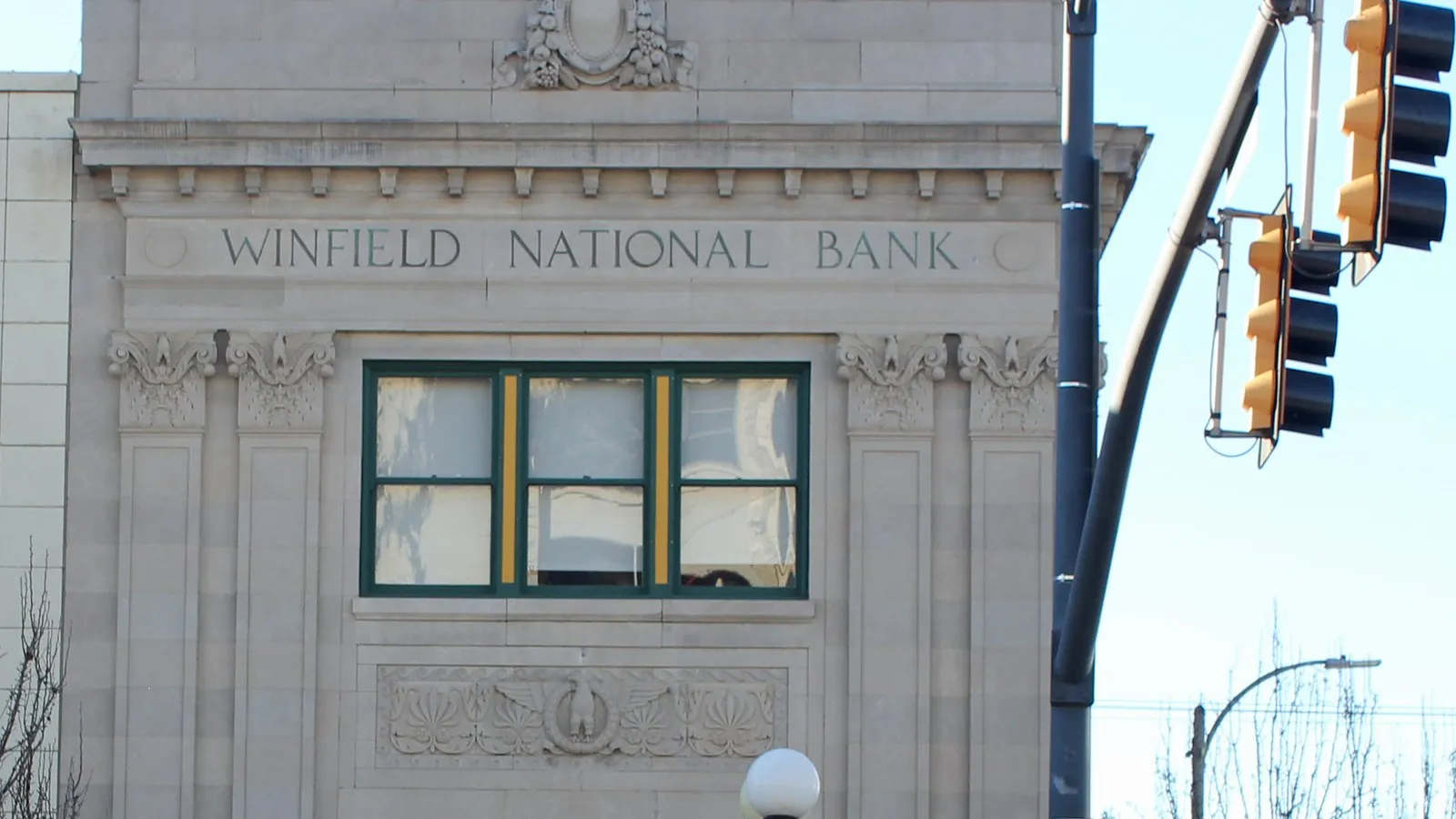

The carved letters across the top of 901 Main Street still read “Winfield National Bank,” though no bank has done business inside since 1945. The limestone building on the southwest corner of Ninth and Main is the third bank to stand on that lot, and the story of how it got there runs back to the first months of Winfield itself.
Most of what is known about the building comes from its National Register of Historic Places nomination, prepared for the Kansas State Historical Society in 2011. The building was added to the register in January 2012, for its place in the town’s early commerce and as an example of a Classical Revival bank.
A frame building, a brick bank, then limestone
J.C. Fuller, one of the town’s founders, arrived in Winfield in August 1870 and opened the first banking house in Cowley County, the Winfield Bank, in January 1871. It ran as a private bank out of a one-story frame building on the corner until 1879.
That spring Fuller merged with J.C. McMullen, a Civil War colonel who had been banking in Arkansas City since 1871 and had opened the Citizen’s Bank in Winfield the year before. The combined Winfield Bank put up a two-story brick building on the same corner in the summer of 1879 at a cost of $8,000. The basement later housed The Courier’s newspaper and printing office.
The partnership grew deposits from $50,000 in 1879 to $320,000 in 1883, according to the nomination. Fuller and McMullen sold their stock in 1884 to H.B. Fuller, who took the bank national in 1885. It changed hands again in 1891 and 1911, and by its 50th anniversary in 1921 it reported assets of about $1.27 million.
The 1879 brick bank got a limestone front in 1916. Seven years later the bank tore it down. A January 1923 Courier article quoted in the nomination said the new building would be 25 by 100 feet, built of Carthage limestone, with the bank on the ground floor and offices upstairs reached by a stairway off Ninth Street. The contract went to the American Fixture Co., whose architects also designed it.
What to look for from the sidewalk
The front facing Main Street is a “temple front”: paired pilasters with Corinthian capitals frame a recessed entrance, under a bracketed cornice and a tall parapet with a carved cartouche at the center. A carved stone panel with an eagle sits between the door transom and the upper windows. The long Ninth Street side repeats the pilasters on its end bays and carries two balustrades in the parapet.
The ground-floor windows are the modern touch. Instead of the single fixed panes common on banks of the period, they are steel Chicago-style windows with a fixed center pane, opening casements on each side and three-light transoms.
Inside, the 2011 survey found much of the original bank intact: a two-tone terrazzo floor and marble wainscoting in the lobby, two vaults at the back, and mezzanine offices overlooking the banking floor. The original plaster ceiling, with dentils, leaf bands and gilded rope molding, was still in place above a later dropped ceiling. Upstairs, a row of offices with small private waiting rooms had been used by a doctor’s practice.
Four banks on one intersection
The building is a reminder of how much money once changed hands at Ninth and Main. The 1888 city directory boasted of “three magnificent buildings” at the corner owned by the First National, Winfield National and Farmers banks. Within a few years there was a bank on every corner, including the Cowley County National Bank in its 1886 limestone building across Main, which is also on the National Register.
Winfield National came through the Great Depression without losing a depositor’s dollar, the nomination says, helped by rent from its upstairs tenants. A 1928 statement showed just over $2 million in deposits.
The end came by sale, not failure. In 1945 the First National Bank of Miami, Okla., controlled by the Mullendore family of cattlemen and bankers, bought control of Winfield National. The merged bank moved across the street to the First National Bank building at 900 Main, ending a 74-year run. The building was listed as vacant when it was nominated in 2011.
Listing on the National Register does not stop an owner from changing a building, but it can open the door to state and federal historic tax credits for an approved rehabilitation. Winfield also offers a property tax rebate on qualifying improvements through its neighborhood revitalization plan, which is up for renewal for 2027 through 2029.
For more of the town’s 19th-century buildings, see our stories on Bryant School, home of the Cowley County Historical Museum, and the W.P. Hackney house on 10th Avenue.