Charles Koch: The Wichita Native Behind Koch Inc.
Charles Koch, 90, has led Wichita-based Koch Inc. since 1967. A profile of his career, the Georgia-Pacific deal, his philanthropy and his Kansas ties.
By Garrett Pruitt
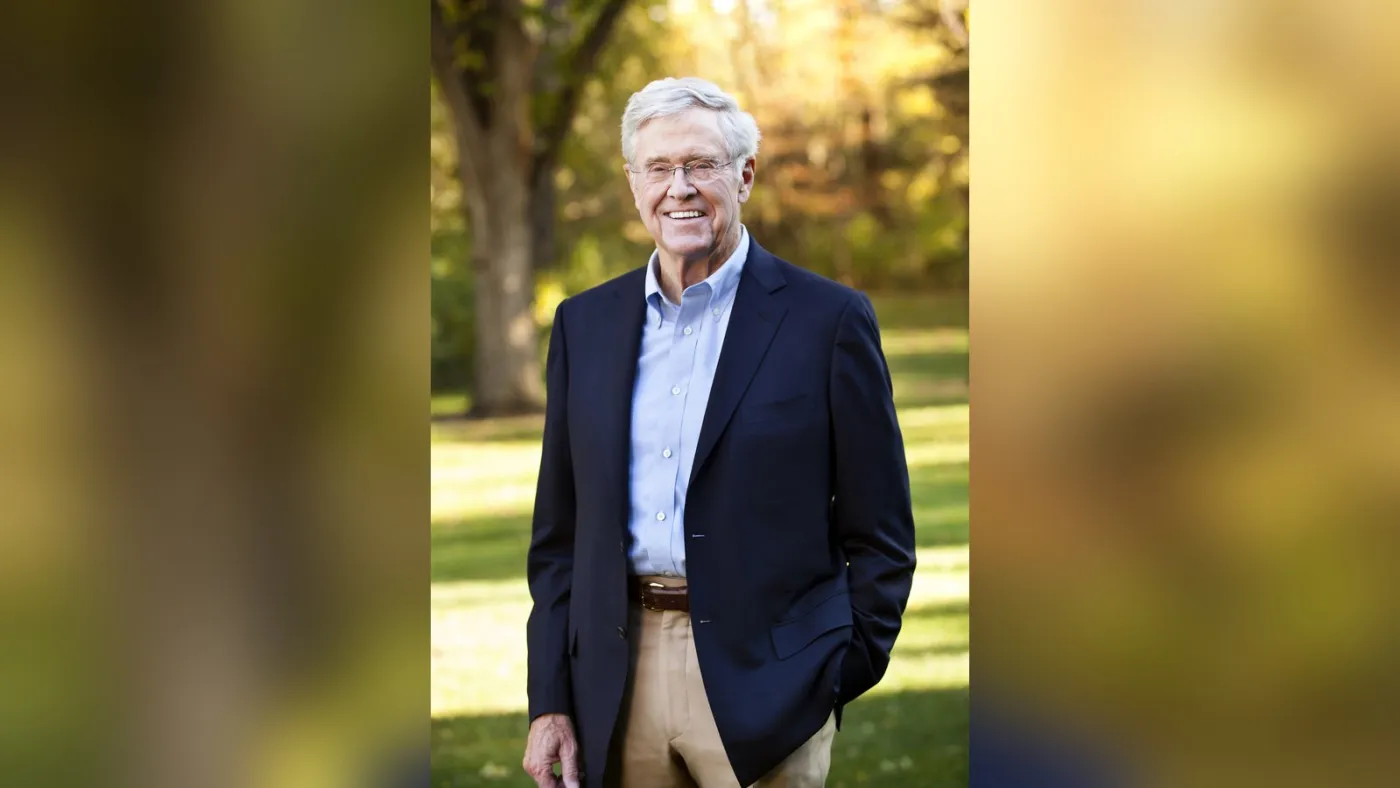
Charles Koch has run the same Kansas company for nearly six decades. Born in Wichita on Nov. 1, 1935, he turned 90 last fall as chairman and chief executive of Koch Inc., a privately held business that grew from a regional oil operation into one of the largest companies in the country. He is also a major donor in American public life, a role that has drawn both praise and sustained criticism.
From Wichita to MIT and back
Koch is one of four sons of Fred Chase Koch and Clementine Robinson Koch. His father had developed a crude oil refining process and founded the family business in 1940. Charles attended several private high schools before enrolling at the Massachusetts Institute of Technology, where he earned a bachelor’s degree in general engineering in 1957, a master’s in nuclear engineering in 1958 and a second master’s in chemical engineering in 1959.
He first worked for the consulting firm Arthur D. Little. In 1961 he returned to Wichita to join his father’s company, then called Rock Island Oil & Refining. He became its president in 1967 and has been chairman and chief executive since. The firm took the Koch Industries name, and in 2024 it announced a further change to Koch, Inc., saying the new name reflected its broader scope.
Control of the business was not always settled inside the family. In 1983, the stakes held by his brothers Frederick and Bill were bought out for $1.1 billion, leaving Charles and his brother David as majority owners. Legal disputes among the brothers dragged on until 2001, when CBS News reported a $25 million settlement. David Koch, who died in 2019, remained his partner in the company and in much of their giving.
Building the company
Under Charles Koch the company expanded well beyond refining and pipelines. Its subsidiaries have included Flint Hills Resources, Invista, Molex, Guardian Industries and Infor. Its largest deal came in 2005 with the acquisition of Georgia-Pacific, the paper and pulp products maker. According to Wikipedia, the company’s revenue was $125 billion in 2021, and it employs roughly 120,000 to 122,000 people in about 60 countries. Forbes has described it as the largest privately held company in the United States by revenue.
Koch has also written about how he runs it. His approach, which he calls Market-Based Management, is laid out in the 2007 book The Science of Success and elsewhere. He has since published Good Profit in 2015 and Believe in People in 2020. In May 2025, the Bloomberg Billionaires Index estimated his net worth at $71.4 billion, which ranked him 22nd in the world at the time.
Giving and politics
Koch helped found the Cato Institute in 1977, along with Edward H. Crane and Murray Rothbard. He has also backed the Institute for Humane Studies, the Mercatus Center at George Mason University and the Bill of Rights Institute. The Charles G. Koch Foundation funds programs at nearly 200 American colleges and universities, and its summer fellowship has supported more than 900 students.
His political spending has been a constant source of debate. He and his brother David supported groups that opposed the Obama administration and backed the Tea Party movement, and they funded advocacy groups that opposed climate regulation. Koch has said humans contribute to climate change but has objected to top-down government mandates. He has also supported cannabis legalization and opposed ethanol subsidies. In November 2020 he said he regretted his part in deepening partisan division. In 2025 he received the Milton Friedman Prize for Advancing Liberty.
The Kansas connection
Koch’s ties to Kansas run through Wichita, where the company is headquartered and where he has a residence. The best-known local mark of his giving is at Wichita State University. He gave $6 million in 2002 toward the school’s basketball arena, which was later renamed Charles Koch Arena, and another $11.25 million in December 2014. He also received an honorary doctorate from Washburn University in Topeka.
The sources reviewed for this profile did not identify a Koch facility or personal connection in Winfield or Cowley County. For readers here, the link is the statewide one: one of the country’s biggest private companies is run from a Kansas city, by a Kansas native.
Sources: Wikipedia entries on Charles Koch and Koch Industries.